

Half Man--Review
(The Show So Good That It Makes You Want to Throw Yourself off a Rooftop)

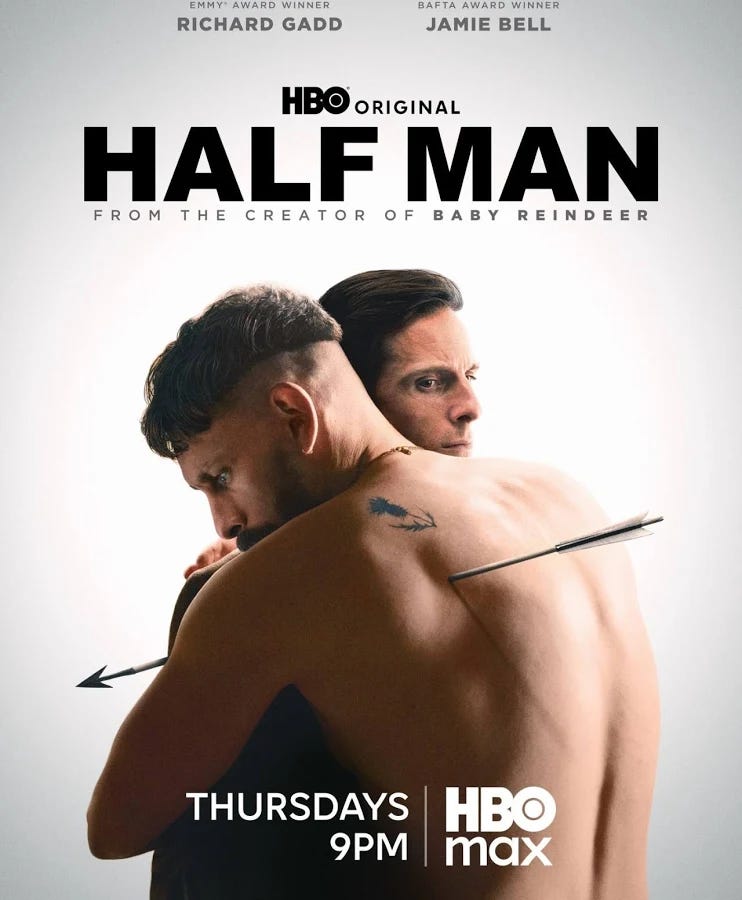
There are some shows that build up humanity, praising our strength and resilience, urging us to become better people.
Some shows—but not this one. Not in the least.
Half Man, created by and starring Richard Gadd, who held the same duties on Baby Reindeer, is a whirling dervish of madness and mayhem, with a helping of pitch-black humor mixed in.
The show boasts four of the best performances I’ve seen on any screen, big or small. Gadd and his co-star Jamie Bell, who plays the older Niall, are fearsome, vulnerable, and profoundly human.
The plot careens from present to past and back again with whiplash speed. Directors Alexandra Brodski and Eshref Reybrouck take particular care never to disorient the viewer despite the show's constant shifts in time. The editing makes the temporal jumps feel almost subconscious, allowing past and present to bleed into one another.
Half Man opens at the wedding of Niall and his partner, a scene set in the 2010s to which Gadd repeatedly returns, before flashing back to the late 1980s, when Ruben (Stuart Campbell) and Niall (Mitchell Robinson) first meet after their mothers become domestic partners.
From then on, Niall is half in awe and half terrified of Ruben, who is brawny, profane, and already exhibits the sadistic tendencies that will define him as an adult.
Early in the series, Niall and Ruben encounter the boys who have terrorized Niall for years on their walk to class.
Of course, the boys begin bullying Niall, who is saved from further humiliation by Ruben. Once they are clear of Niall’s tormentors, Ruben asks Niall’s permission to go back and clear the bullies out. Niall never verbally gives his okay, but he doesn’t say no, either.
So, Ruben, the most dangerous tormentor of them all, goes back and takes care of business. As a result, Niall’s classmates stay clear of him.
This scene sets up the co-dependency the two characters feel towards one another throughout the whole series—billed as a limited series (probably a good thing—I don’t know if viewers could take much more, it’s so harrowing).
It also serves as a showcase for the talents of Campbell and Robinson. It is clear that they also are wonderful collaborators even with other actors with whom they don’t share a scene. They don't merely imitate Gadd and Bell; they inhabit the younger versions of those characters so completely that the transition feels effortless.
The show goes on to chronicle the journey of these two men, and the lengths to which Ruben will go to control Niall. What makes Half Man distinctive is that Niall doesn't simply endure Ruben's control—he craves it, even as it destroys him.
Like The Sopranos and Breaking Bad, Half Man centers on a magnetic antihero. Unlike those series, however, its real subject is the psychological bond between abuser and victim. In a furious, charismatic performance laced with equal parts vitriol and humor, Gadd is magnetic. Like James Gandolfini and Bryan Cranston before him, he commands every scene he’s in.
After watching this, it's clear that Ruben belongs alongside television's great antiheroes: Tony Soprano, Walter White, Don Draper, and a handful of others. These men rip themselves and everyone around them to shreds.
Having said that, Bell arguably has the most difficult role of the two. While Gadd delivers the flashier performance, Bell is almost milquetoast in comparison. But just as toxic.
Niall uses the characters around him to help hide who he is: a gay man distinctly uneasy with his place in the world. A writer, he allows Ruben to compose his story with little input from the source himself. Why does he allow Ruben to do this? Perhaps because it's easier to accept someone else's version of you than to discover who you really are.
Bell plays this character with seeming ease, giving a master class in how to portray an unlikable man without ever sacrificing his humanity. It’s a reminder to the viewer that few people are either villains or heroes. We all have good and bad impulses warring within us continually.
As the show progresses toward its inevitably morose conclusion, the final two scenes pack an emotional punch that elevates the series from a harrowing character study into something genuinely heartbreaking. The dramatic tension in those final moments rivals anything I've seen on American television this year.
_____
Half Man is streaming on HBO Max.
_____
The next review I have planned is Christopher Nolan's The Odyssey, hopefully shortly after it opens on July 17. Of course, that depends on whether I can sell a kidney first—ticket prices being what they are. If I can get my daughter to spring for Apple TV, I’ll probably review Widow’s Bay before then.
What can I say? Times are tough.